
Qalandiya, Tue 28.8.12, Morning
Translator: Charles K.
06:00 A cool breeze, almost autumnal. No sea squills or migrating birds here, just concrete barriers, garbage and endless dust, though the slightly cool morning reminds us that things change even here.
Qalandiya is taking on a different character, and we have to get used to it. The new arrangements quickly change people’s habits. The lines haven’t disappeared, but they move faster. Whenever a line forms, sometimes stretching all the way to the parking lot, it quickly disappears, and then a new long, congested line forms, which also disappears before the next forms. It feels as if everyone arrives later because they know crossing time will be shorter. The plaza is still very crowded for two hours, but people are sure that inspections within will be speeded up and unbearably long lines won’t be allowed to form. There are DCO staff members at the inner plaza along with police, military police, security personnel and soldiers. The humanitarian gate opens every few minutes. Some of the pupils have returned and we manage to help an old woman cross in a remarkably short time.
At 07:45 the lines seem to have come to an end, and at 08:00 we decided to return to Jerusalem.
There may have been an upheaval at the vehicle checkpoint. This is the second time we’ve seen IDs inspected and returned immediately; the whole process is conducted very quickly. The vehicle checkpoint has matured; one day it will be like Hizma.
A final reminder – the Qalandiya vehicle checkpoint is one of the vehicle entry checkpoints to Jerusalem. Because it adjoins the Qalandiya pedestrian checkpoint, its rules differed thus far from those at other checkpoints, though the vehicles are the same vehicles and those crossing aren’t any different – cars with Israeli plates belonging to Palestinians and Israelis.
The rules at the vehicle checkpoints between the West Bank and Israel are designed for the comfort of Israelis, to speed their crossing. Security, in whose name the various strange inspections are carried out, including ambulances delayed and private cars, is a completely random outcome.
For example, someone driving from Ariel on Highway 5, from the West Bank, will undoubtedly reach the center of the country quickly, because if cars are delayed there the traffic jam would be endless. We recent read in the newspaper about Palestinians travelling by bus to the center of the country. What’s the problem – they’re not inspected, and they also take the places of settlers on the buses. I don’t recall which complaint was louder, but it’s clear that it’s a much faster and cheaper way to get to work.
And at Jerusalem – a Palestinian resident of Jerusalem driving a car with Israeli plates can enter Jerusalem via the Hizma checkpoint quickly and with no inspection. He’ll also cross relatively quickly at Anata.
But if that same Palestinian resident of Jerusalem travels via Qalandiya his passengers, also Palestinian residents of Jerusalem, will cross through the pedestrian checkpoint, unless they’re first-degree relatives of the driver. And the driver will wait a long time at the vehicle checkpoint, hear loud yelling over the huge loudspeaker above him, and his car and documents will finally be inspected according to the whims of whichever soldiers are conducting the inspection at that moment. My car was inspected at every crossing, but in addition to the so-called standard opening of the trunk I was asked more than once to expose the spare tire and open the hood. And often to report on the exact contents of handbags and what they’re used for.
Now the rules have changed, and this is the second week we cross quickly with no inspection, just a glance at our IDs, and all the other cars go through the same way, of course.
Let’s hope this is the last time the vehicle checkpoint stars in the morning reports, and perhaps on the eve of the new year the checkpoints and walls will tumble down.
Qalandiya Checkpoint / Atarot Pass (Jerusalem)
See all reports for this place-
Click here to watch a video from Qalandiya checkpoint up to mid 2019 Three kilometers south of Ramallah, in the heart of Palestinian population. Integrates into "Jerusalem Envelope" as part of Wall that separates between northern suburbs that were annexed to Jerusalem in 1967: Kafr Aqab, Semiramis and Qalandiya, and the villages of Ar-Ram and Bir Nabala, also north of Jerusalem, and the city itself. Some residents of Kafr Aqab, Semiramis and Qalandiya have Jerusalem ID cards. A terminal operated by Israel Police has functioned since early 2006. As of August 2006, northbound pedestrians are not checked. Southbound Palestinians must carry Jerusalem IDs; holders of Palestinian Authority IDs cannot pass without special permits. Vehicular traffic from Ramallah to other West Bank areas runs to the north of Qalandiya. In February 2019, the new facility of the checkpoint was inaugurated aiming to make it like a "border crossing". The bars and barbed wire fences were replaced with walls of perforated metal panels. The check is now performed at multiple stations for face recognition and the transfer of an e-card. The rate of passage has improved and its density has generally decreased, but lack of manpower and malfunctions cause periods of stress. The development and paving of the roads has not yet been completed, the traffic of cars and pedestrians is dangerous, and t the entire vicinity of the checkpoint is filthy. In 2020 a huge pedestrian bridge was built over the vehicle crossing with severe mobility restrictions (steep stairs, long and winding route). The pedestrian access from public transport to the checkpoint from the north (Ramallah direction) is unclear, and there have been cases of people, especially people with disabilities, who accidentally reached the vehicle crossing and were shot by the soldiers at the checkpoint. In the summer of 2021, work began on a new, sunken entrance road from Qalandiya that will lead directly to Road 443 towards Jerusalem and Tel Aviv. At the same time, the runways of the old Atarot airport were demolished and infrastructure was prepared for a large bus terminal. (updated October 2021)
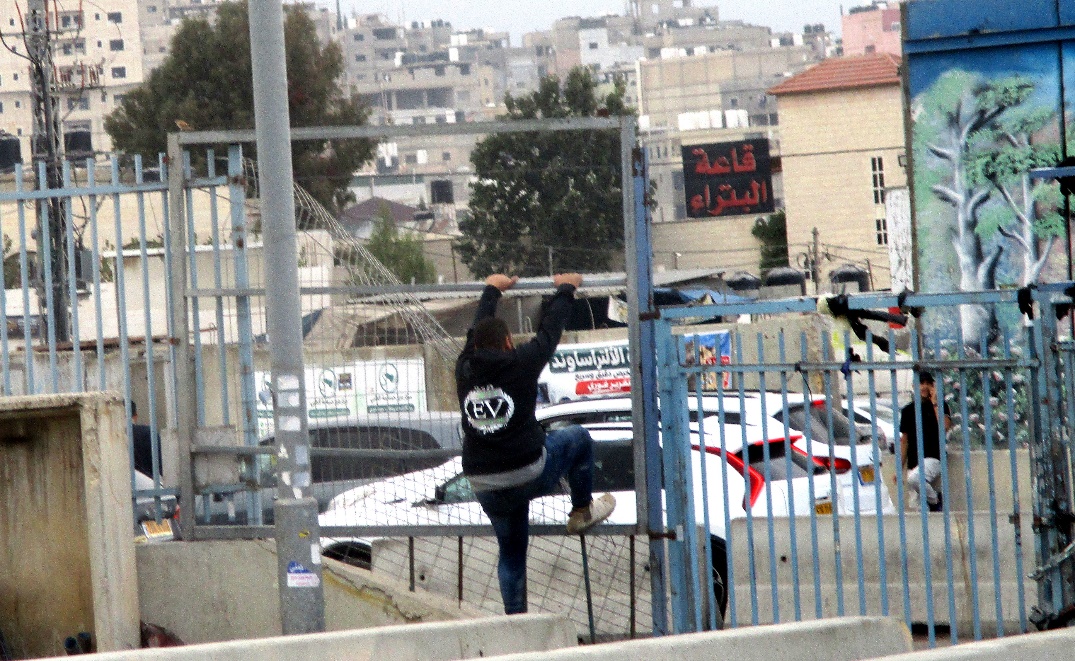 Tamar FleishmanOct-27-2026Qalandiya. Closure – Climbing over the fence
-
