
Qalandiya, Wed 8.2.12, Morning
Translator: Charles K.
We arrived at the checkpoint a few minutes past 5 AM; 500-600 people were already waiting on line. Two booths were open; the line moved very slowly. The “humanitarian” crossing is closed, of course. The IDF hasn’t learned, and apparently won’t learn, because it doesn’t want to learn, that the 24 hours in the day can be divided not only by 8 or by 6, but also by 4 or by 2. The promise to carry out the shift change at 4 or 5 AM from the beginning of the year has the same status as who-knows-how-many other promises we’ve heard during the past eleven years. At 6 AM – the busiest time – life comes to a halt and the soldiers change shifts so slowly that a tortoise would be embarrassed. They share some gossip from the night that’s just ended, kiss, hug, get organized a little and then slowly drag themselves into position. But if we thought things would improve much after the shift change – we were wrong, so very wrong. Meanwhile a huge commotion in the “cages,” people push and are pushed, the shouting can be heard from a distance, the sight is disgraceful. The revolving gate opens every few minutes for only a minute or two. And as we’ve seen for years now – some people become trapped inside. But “they’re used to it,” “they know” – because, after all, they’re only “sub-humans,” “terrorists” – anyway, who even sees them…
Many people wait for the “humanitarian” crossing to open. We’ve known many of them for years. A., from the DCO, appears accompanied by someone from the company that manages the checkpoint, dressed in the security company’s uniform. Another security/police person with them, well known to us. If we ever decide to make a movie about “the enemies of humanity,” he’ll be the film’s hero. Finally, at 6:10 AM, the gate opens and the flow of people waiting begins bursting through. The company representative starts sorting them. Suddenly he “comes upon” a relatively young man who says he’s employed by the church and is allowed to use the “humanitarian” crossing. Wow…what a liar…the security man has finally gotten his pound of flesh, can now demonstrate his power, show he’s in charge. His mouth opens, pearls flow like Niagara after the snows. Meanwhile a young man joins the scene, raises his shirt and shows “the hero of Israel” that his ribs were injured in the press, adhesive bandages cover much of his chest. We tried to intervene on his behalf – but then…the hero began directing his pearls at us. “How do you know he’s not faking? Who believes Palestinians anyway?” And to the young man – “Why should I have any consideration for you. All you want is to kill me.” We almost said, “So do we” – but violence isn’t really our way of behaving, neither at the checkpoint nor elsewhere. We complained – but who are we compared to “the heroes of Israel, guardians of the homeland”?
As always, the people on line asked us whether we think what goes on at Qalandiya will bring peace closer, whether animals aren’t treated more humanely, and many more tough, justifiable questions. To think we’ve been going to Qalandiya for 11 years, and things only get worse.
In the evening we met a group from the US who crossed through Qalandiya during the lull – it was empty, no one waited on line. I asked them what they thought about the place and saw they were embarrassed. I encouraged them to speak freely – “It looks like a slaughterhouse” – “Is that how people cross every day?” – “Isn’t Israel ashamed?” I had to admit that shame is no longer part of Israel’s vocabulary.
And we’ll continue with what we’re doing; we won’t despair – for the Palestinians and for ourselves.
Qalandiya Checkpoint / Atarot Pass (Jerusalem)
See all reports for this place-
Click here to watch a video from Qalandiya checkpoint up to mid 2019 Three kilometers south of Ramallah, in the heart of Palestinian population. Integrates into "Jerusalem Envelope" as part of Wall that separates between northern suburbs that were annexed to Jerusalem in 1967: Kafr Aqab, Semiramis and Qalandiya, and the villages of Ar-Ram and Bir Nabala, also north of Jerusalem, and the city itself. Some residents of Kafr Aqab, Semiramis and Qalandiya have Jerusalem ID cards. A terminal operated by Israel Police has functioned since early 2006. As of August 2006, northbound pedestrians are not checked. Southbound Palestinians must carry Jerusalem IDs; holders of Palestinian Authority IDs cannot pass without special permits. Vehicular traffic from Ramallah to other West Bank areas runs to the north of Qalandiya. In February 2019, the new facility of the checkpoint was inaugurated aiming to make it like a "border crossing". The bars and barbed wire fences were replaced with walls of perforated metal panels. The check is now performed at multiple stations for face recognition and the transfer of an e-card. The rate of passage has improved and its density has generally decreased, but lack of manpower and malfunctions cause periods of stress. The development and paving of the roads has not yet been completed, the traffic of cars and pedestrians is dangerous, and t the entire vicinity of the checkpoint is filthy. In 2020 a huge pedestrian bridge was built over the vehicle crossing with severe mobility restrictions (steep stairs, long and winding route). The pedestrian access from public transport to the checkpoint from the north (Ramallah direction) is unclear, and there have been cases of people, especially people with disabilities, who accidentally reached the vehicle crossing and were shot by the soldiers at the checkpoint. In the summer of 2021, work began on a new, sunken entrance road from Qalandiya that will lead directly to Road 443 towards Jerusalem and Tel Aviv. At the same time, the runways of the old Atarot airport were demolished and infrastructure was prepared for a large bus terminal. (updated October 2021)
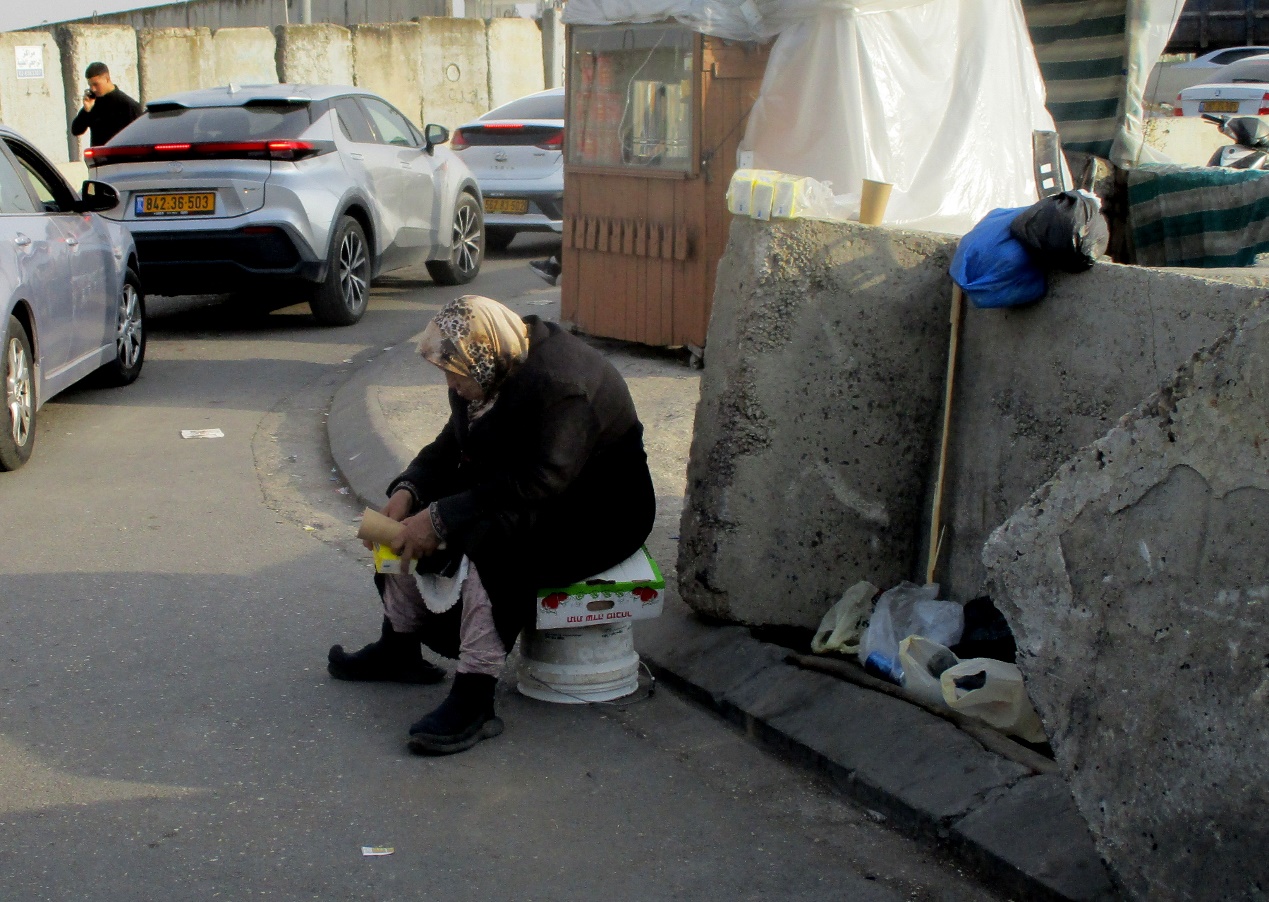 Tamar FleishmanOct-11-2026Qalandiya. Female Beggar
-
